Cart
0

Search for sea moss and iodine and you'll find two opposite stories. One says sea moss is packed with iodine and is great for your thyroid. The other says it's a thyroid risk. The honest answer sits between them, and it depends on three things: which seaweed it is, how much you take, and your own thyroid health. This article walks through what the research actually shows. For the bigger picture on sea moss, start with our guide, Sea Moss: Separating the Research from the Hype.
Why Iodine Matters (and Why Too Much Is a Problem Too)
Your thyroid needs iodine to make thyroid hormones. The U.S. National Institutes of Health sets the recommended daily intake at 150 micrograms (mcg) for most adults, 220 mcg during pregnancy, and 290 mcg while breastfeeding. It also sets a tolerable upper intake level of 1,100 mcg per day for adults, including during pregnancy and breastfeeding.
Iodine is one of those nutrients where both too little and too much can cause trouble. High intakes can cause goiter, elevated TSH, and hypothyroidism, which are the same problems seen in deficiency. They can also cause iodine-induced hyperthyroidism and thyroiditis. The NIH also notes that people with autoimmune thyroid disease may react badly at intakes considered safe for the general population.
Not All Seaweed Is Equal
"Seaweed" covers hundreds of species, and their iodine content is wildly different. The NIH reports that commercially available whole and sheet seaweeds range from 16 to 2,984 mcg of iodine per gram, and that amounts vary greatly even between species.
A Norwegian study tested 96 seaweed-based products, including whole seaweeds, foods containing seaweed, and supplements. Iodine ranged from 128 to 62,400 mcg per portion in whole seaweed products, and from 5 to 5,600 mcg per daily dose in supplements. More than half of the products (54 of 96) could push intake above the tolerable upper limit at a normal serving. It was also found that iodine labeling was inadequate or inaccurate for several products.

| Seaweed | Average iodine (mcg per gram, dry) | What it means |
|---|---|---|
| Irish moss (Chondrus crispus) | About 3.9 | Low in the one published analysis found |
| Kombu (a kelp) | About 2,276 | Very high |
| Sugarkelp | About 4,469 | Very high |
| Oarweed (a kelp) | About 7,800 | Extremely high |
The Irish moss figure comes from a 2020 analysis of 30 red seaweed samples, in which Irish moss averaged about 3.9 mcg of iodine per gram. At that level, an adult would need to eat roughly 285 grams of dried Irish moss a day, which is a huge amount, to reach the upper limit from that seaweed alone. The research also found no apparent health risk from eating 4 grams a day of the seaweeds tested.
That's reassuring for Irish moss specifically, but it isn't a free pass. It's one analysis, and the kelp numbers show how far the range stretches. It's also worth knowing that "sea moss" is a loose market term. It can mean Irish moss, or other red seaweeds grown in tropical waters, and these can have different iodine profiles. Harvest, season, and processing all affect the final amount, so the species on the label and a batch-specific test matter more than the general category.
Who Should Be Most Careful
The American Thyroid Association identifies infants, older adults, pregnant and breastfeeding women, and people with existing thyroid disease as most susceptible to harm from excess iodine. If you have hypothyroidism, hyperthyroidism, Hashimoto's, Graves' disease, or thyroid nodules, talk to your doctor before taking any seaweed product regularly. That includes sea moss, even though Irish moss looks lower in iodine than most kelp.
Kelp supplements deserve a special warning. The Association advises against kelp and iodine supplements that provide more than 500 mcg of iodine a day, and notes that some products contain many times the tolerable upper limit.
What to Check Before You Take Sea Moss
- The species. The label should name the seaweed, for example Chondrus crispus, not just "sea moss" or "seaweed blend."
- A batch-specific Certificate of Analysis. Ideally it shows iodine content per serving along with heavy metals and microbiology. Many seaweed products never state their iodine content.
- The serving size. Capsules containing a few hundred milligrams of powder are a very different exposure from several grams of dried seaweed or a daily spoonful of gel.
- Your total iodine. Multivitamins, prenatal vitamins, and kelp products all count. Check the labels together.
- Your thyroid history. If you have any thyroid condition, or you're pregnant or breastfeeding, ask your doctor first.
Frequently Asked Questions
Does sea moss have a lot of iodine?
It depends on the seaweed. Kelp is extremely high. Irish moss (Chondrus crispus) averaged much lower in the one published analysis we found, about 3.9 mcg per gram. Tested numbers for any specific product are the only reliable answer.
Is sea moss safe if I have hypothyroidism or Hashimoto's?
There's no one-size-fits-all answer. Because people with autoimmune thyroid disease can be sensitive to iodine, this is a conversation for your doctor, ideally with the product's iodine content in hand.
How much sea moss is too much?
There's no single number, because it depends on the species, the batch, and your own iodine intake. Following the serving size on a product that has been tested, and not stacking it with other iodine-rich supplements, is the safest approach.
Can sea moss treat a thyroid problem?
No. Nothing in this research supports using sea moss to treat a thyroid condition, and too much iodine can make some thyroid conditions worse.
The Bottom Line
Sea moss isn't automatically an iodine bomb, and it isn't automatically safe either. Iodine content varies enormously across seaweeds, and the numbers behind marketing claims, in either direction, are often missing. The practical rule is simple: know the species, look for tested iodine numbers, keep an eye on your total intake, and involve your doctor if you have thyroid issues.
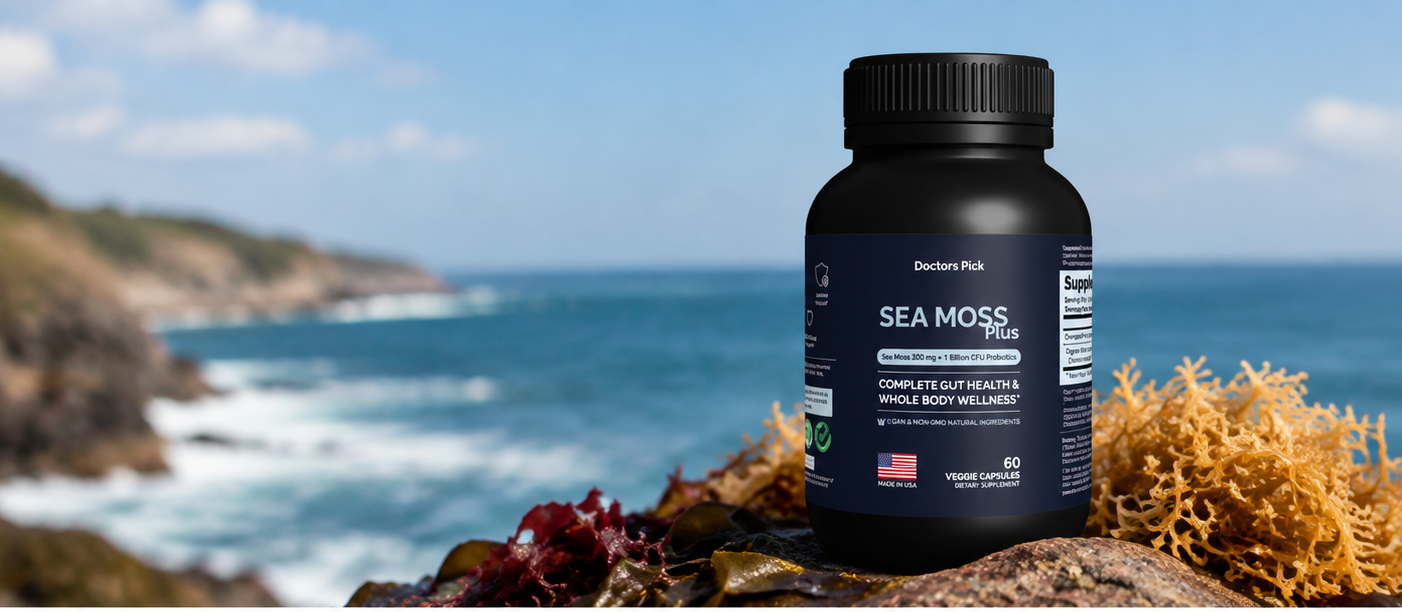
For reference, Sea Moss Plus contains 300 mg of organic Irish sea moss powder (Chondrus crispus) per serving, alongside a probiotic blend. As always, if you have a thyroid condition or are pregnant or nursing, check with your healthcare provider before using it.
These statements have not been evaluated by the Food and Drug Administration. This product is not intended to diagnose, treat, cure, or prevent any disease.
Sources
- NIH Office of Dietary Supplements — "Iodine: Fact Sheet for Health Professionals" (recommended intakes, upper limit, seaweed iodine range, effects of excess). link
- American Thyroid Association — "ATA Statement on the Potential Risks of Excess Iodine Ingestion and Exposure" (at-risk groups, kelp supplement advice). link
- Darias-Rosales J, et al. "Risk assessment of iodine intake from the consumption of red seaweeds (Palmaria palmata and Chondrus crispus)." Environmental Science and Pollution Research, 2020;27:45737–45741. link
- "Commercially available kelp and seaweed products – valuable iodine source or risk of excess intake?" Food & Nutrition Research (96 Norwegian products; iodine ranges, species averages, labeling). link