Cart
0
Sea Moss: Separating the Research from the Hype
Sea moss went from a niche Caribbean and Irish tradition to a TikTok sensation almost overnight. Scroll for five minutes and you'll see claims that it contains "92 of the 102 minerals your body needs," cures everything from sluggish thyroids to dull skin, and belongs in every smoothie you drink.
Some of that is real. A lot of it isn't. Here's what the actual research says — including the parts most sea moss brands don't want to talk about.

Where the "92 Minerals" Claim Actually Comes From
This is the single most repeated sea moss claim online, and it's worth addressing directly. The claim traces back to herbalist Alfredo "Dr. Sebi" Bowman, who wasn't a physician or nutrition scientist. Its exact origin — why 92, specifically — isn't clearly documented, and no published compositional lab analysis of sea moss has verified 92 distinct minerals present at nutritionally meaningful levels.
Two things are worth separating here, because they get blurred together in most sea moss marketing:
- Whether trace elements are technically present. Seaweed does reflect the mineral profile of the water it grows in, so sea moss can contain small amounts of a wide range of elements — this part is plausible and not really in dispute.
- Whether "92 minerals" is a meaningful nutritional claim. This is where the number falls apart. Human nutrition science recognizes roughly 15–20 essential trace minerals — not 102 total — so "92 of the 102 your body needs" doesn't map onto how nutrition science actually categorizes essential minerals in the first place. And presence in trace, ultra-trace amounts isn't the same as presence in amounts your body can meaningfully use.
That doesn't mean sea moss is mineral-poor. It genuinely does contain iodine, calcium, magnesium, potassium, iron, and zinc in amounts that matter. But "genuinely contains several nutritionally relevant minerals" and "contains 92 essential minerals your body needs" are two very different claims, and only one of them holds up. If a brand's entire pitch rests on the 92-minerals figure without a lab analysis to back it up, that's worth treating as a red flag rather than a selling point.

The Real Story: Sea Moss and Gut Health
This is where sea moss has its strongest legitimate case — though it's a narrower and more specific case than most marketing suggests.
Sea moss contains soluble fiber and sulfated polysaccharides — carbohydrate compounds that your digestive system can't fully break down on its own. Instead, they pass through to the large intestine, where gut bacteria ferment them. This is the same basic mechanism behind well-established prebiotic fibers like inulin or resistant starch: the fiber itself isn't the active ingredient so much as the fuel source for bacteria that are.
Preliminary research, including animal studies, has shown improvements in gut microbiota composition after sea moss consumption, along with signals of immune modulation. That's a genuinely promising early signal. The honest caveat is that it's early — most of the strongest, most rigorous clinical research on gut and immune outcomes comes from spore-forming probiotic strains studied independently in randomized, placebo-controlled human trials, not from sea moss consumed on its own in comparable human trials.
That distinction matters more than it might seem. A prebiotic fiber and a probiotic organism do fundamentally different jobs:
- Prebiotics (like sea moss fiber) feed the beneficial bacteria that are already in your gut
-
Probiotics (like specific Bacillus strains) are live organisms that arrive and can temporarily add to that bacterial population
Sea moss's fiber can reasonably be expected to feed the gut bacteria you already have. What it hasn't been shown to do is add new, studied bacterial strains the way a probiotic supplement does — that's a different mechanism, and it's not what the current sea moss research actually measured.
Sea Moss Plus includes Bacillus coagulans, a spore-forming probiotic. Curious what the clinical trials on that species actually show? Read Bacillus Coagulans and IBS: What the Clinical Trials Actually Found.
The Part Most Brands Skip: Iodine and Thyroid Safety
Here's the section you won't find on most sea moss product pages, and it's the one that matters most for anyone actually deciding whether to take this regularly.
Seaweed is one of the richest natural sources of iodine, but how much depends enormously on the type. Kelp species can contain thousands of micrograms per gram, while the one published analysis of Irish sea moss (Chondrus crispus) found a much lower average, about 4 micrograms per gram. Because "sea moss" is a loose market term, harvest and processing vary, and many seaweed products don't state their iodine content, a batch-specific Certificate of Analysis is still the only way to know what's in a particular product.
The adult tolerable upper intake level for iodine is 1,100 micrograms per day. Some seaweeds, especially kelp, can exceed that in a single serving. Irish sea moss appears to be far lower, but the amount varies by species and product, and iodine from other supplements and foods adds up.
For a closer look at the numbers, see Sea Moss and Iodine: What You Actually Need to Know.
For most healthy adults without a thyroid condition, occasional sea moss consumption within a reasonable dose isn't typically a concern — your thyroid has some capacity to regulate iodine uptake. But for people with existing thyroid conditions, the picture changes:
- Hypothyroidism risk: Excess iodine can trigger the Wolff-Chaikoff effect, a protective mechanism where the thyroid temporarily shuts down hormone production in response to an iodine surge — which can worsen an already underactive thyroid.
- Hyperthyroidism risk (Jod-Basedow effect): In people with thyroid nodules or latent Graves' disease, a sudden excess of iodine can do the opposite — triggering the thyroid to overproduce hormone.
This isn't a rare edge case; it's well-documented endocrinology, and it's the reason legitimate health sources consistently recommend a conversation with a doctor before regular sea moss use if you have any thyroid history — hypothyroidism, hyperthyroidism, Hashimoto's, or known nodules.
There's a second, less-discussed risk worth naming directly: because sea moss absorbs whatever is present in the water it grows in, it can also accumulate heavy metals — arsenic, lead, and mercury — if harvested from contaminated coastal waters. This is precisely why third-party testing matters more for sea moss than for almost any other common supplement ingredient. A product without a published Certificate of Analysis covering both iodine content and heavy metals isn't one we'd recommend taking on faith, regardless of how the brand markets it.

Sea Moss vs. Other Common Seaweeds
Sea moss (Chondrus crispus) is often lumped in with other seaweed supplements, but they're not interchangeable — iodine content especially varies enormously by species.
| Seaweed | Common name | Iodine level | Notes |
|---|---|---|---|
| Chondrus crispus | Irish sea moss |
Low in the one published analysis (about 4 mcg per gram) |
Most common in capsule/gel supplements |
| Laminaria species | Kelp | Very high | Among the most iodine-dense seaweeds; higher overdose risk |
| Spirulina | Spirulina | Low | Not a significant iodine source; different nutrient profile entirely (protein-focused) |
| Undaria pinnatifida | Wakame | Moderate to high | Common in miso soup; culinary portions are typically small |
If you're choosing between seaweed supplements specifically for iodine or thyroid support, this variation is exactly why "seaweed" as a category is too broad a claim — the actual species, and the specific batch's tested iodine content, are what determine whether a given product is appropriate for you.

Frequently Asked Questions
Is sea moss actually good for you?
In moderate, tested amounts, yes — it's a legitimate source of soluble fiber, iodine, and trace minerals. The caveat is that "good for you" depends heavily on dose, your existing thyroid health, and whether the product has been tested for contaminants.
Can I take sea moss every day?
This depends entirely on your individual iodine intake from other sources and your thyroid health. Daily use without knowing your product's actual iodine content, or without medical guidance if you have a thyroid condition, isn't something we'd recommend.
Does sea moss help with weight loss?
There's no strong clinical evidence directly linking sea moss to weight loss. Its fiber content may contribute to satiety the way other soluble fibers do, but that's a general fiber effect, not a sea moss–specific one.
Is sea moss safe during pregnancy?
Given the iodine variability and heavy metal accumulation risk, pregnant or breastfeeding individuals should talk to their doctor before using sea moss supplements — iodine needs and risks shift during pregnancy, and untested products carry more uncertainty than the benefit is typically worth.
What should I look for when buying a sea moss supplement?
A published, batch-specific Certificate of Analysis is the single most important thing — it should cover iodine content and heavy metals (arsenic, lead, mercury) at minimum, and clearly identify the species as Chondrus crispus.
So What's the Honest Verdict?
Sea moss isn't a scam, and it isn't a miracle. It's a nutrient-dense sea vegetable with a legitimate but narrower set of benefits than social media suggests — real prebiotic fiber content, a genuine (if variable) mineral profile, and a safety profile that depends heavily on sourcing and testing quality.
The clearest use case for sea moss isn't as a stand-alone cure-all — it's as a complement to ingredients that do have strong clinical backing. Pairing sea moss's prebiotic fiber with spore-forming probiotics from species that have been studied in randomized, placebo-controlled human trials gives you sea moss's real nutritional contribution alongside evidence you can actually verify, rather than asking sea moss to do a job the current research doesn't fully support on its own.
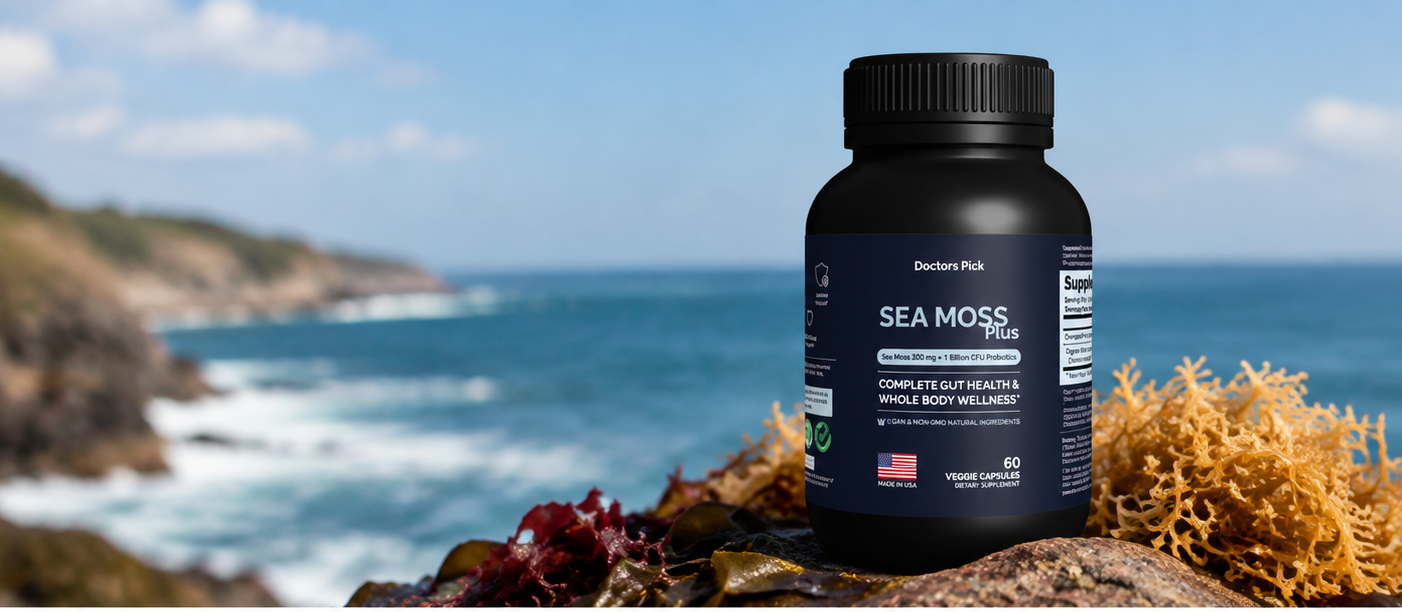
Sea Moss Plus pairs organic Irish sea moss with two spore-forming probiotics, Bacillus coagulans and Bacillus subtilis, and a published Certificate of Analysis covering heavy metals and microbiology.
What to look for if you're buying sea moss:
- A third-party Certificate of Analysis covering iodine content and heavy metals (arsenic, lead, mercury)
- Species labeling that specifies Chondrus crispus (Irish sea moss) rather than a generic "sea moss" blend
- No unqualified "92 minerals" or thyroid-cure claims on the label
- If you have any thyroid condition, a conversation with your doctor before regular use
Sources
Iodine, thyroid physiology, and dosing:
- Institute of Medicine (National Academies) — Dietary Reference Intakes for Iodine — Tolerable Upper Intake Level of 1,100 μg/day for adults — NCBI Bookshelf
- NIH Office of Dietary Supplements — "Iodine: Fact Sheet for Consumers"
- American Thyroid Association — "ATA Statement on the Potential Risks of Excess Iodine Ingestion and Exposure"
- Markou K, et al. — "Iodine-Induced Hypothyroidism," Thyroid (Wolff-Chaikoff effect)
- Pokhrel A, et al. — "Jod-Basedow Phenomenon Following IV Contrast Administration," Cureus, 2022
Heavy metal contamination in seaweed:
- "Heavy metals in seaweed: Implications for health benefits, risks, and safety regulations," ScienceDirect, 2025
- "Dietary exposure to heavy metals and iodine intake via consumption of seaweeds and halophytes in the European population," PMC
General sea moss composition and consumer safety:
- Cleveland Clinic — "8 Potential Health Benefits of Sea Moss"
- FDA Office of Public Safety & Science — "Sea moss in dietary supplements"
- StudyFinds — "TikTok is wrong, sea moss does not contain '92 essential minerals'"
*These statements have not been evaluated by the Food and Drug Administration. This product is not intended to diagnose, treat, cure, or prevent any disease.